
SOFT
FINE
GOODS
CONSULTING
BACK TO THE
WEARABLE TECH
PORTFOLIO
SABER EXOSUITS
FOR THE ARMY
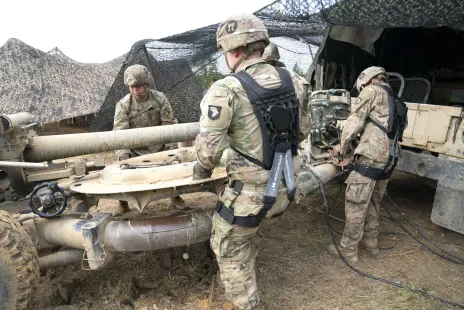
The Pathfinder Project was a million-dollar collaboration between CMI2, Vanderbilt University, and Fort Campbell to develop a soft, passive, lightweight, and thermally comfortable back exosuit aimed at reducing back injuries in Soldiers.



MY ROLE:
As a key contributor, I worked with engineers from Vanderbilt’s Zelik Lab and the design group Interwoven to create multiple exosuit variations compatible with military uniforms and protective gear. I conducted extensive user needs research, performed market analysis, designed surveys for data collection, facilitated focus groups, and led multiple rounds of rapid prototyping and refinement. Additionally, I developed evaluation protocols, collected user feedback, and interpreted data to guide design improvement.
DESIGN PROCESS:
Designing the soft goods for the SABER exosuit meant navigating one of the most demanding wearable tech challenges imaginable: creating a passive back-support system that could be worn seamlessly with military gear without disrupting safety, mobility, or mission performance.
I led the soft goods development on Vanderbilt’s side, using a human-centered design approach guided by the Modified Agile for Hardware Development (MAHD) framework. We began with deep-dive research: mapping soldier environments, daily routines, injury causes, gear configurations, and cultural factors across roles. I conducted focus groups, field interviews, and iterative fittings, using both qualitative and quantitative feedback to shape each new prototype.
Each iteration addressed compatibility issues — from avoiding IOTV quick-release interference to maintaining access to MOLLE loops and tourniquet placement. The suits had to perform under load, through impact, and in thermally stressful environments — all without impeding movement or equipment access. I collaborated directly with Soldiers, refining patterns and soft component structures over dozens of rounds to arrive at a system that integrated naturally with their uniforms and equipment.
DESIGN PHILOSOPHY:
My design philosophy for SABER centered on invisibility through integration. I believe wearable tech succeeds when it disappears into the wearer’s ecosystem — especially in high-stakes environments like the military.
This meant respecting the form, function, and legacy of existing gear. I prioritized human factors, gear compatibility, and fail-safe comfort. A stitch in the wrong place could mean interference with a weapon, a tourniquet, or the ability to escape a vehicle under pressure. Every design decision was filtered through a matrix of injury prevention, thermal comfort, rapid don/doff, and zero interference with soldier readiness.
I don’t believe in compromise when it comes to safety — only alignment. The goal was to support the body without introducing new risk, to amplify performance without getting in the way, and to ensure that every feature served a real, testable need.


